
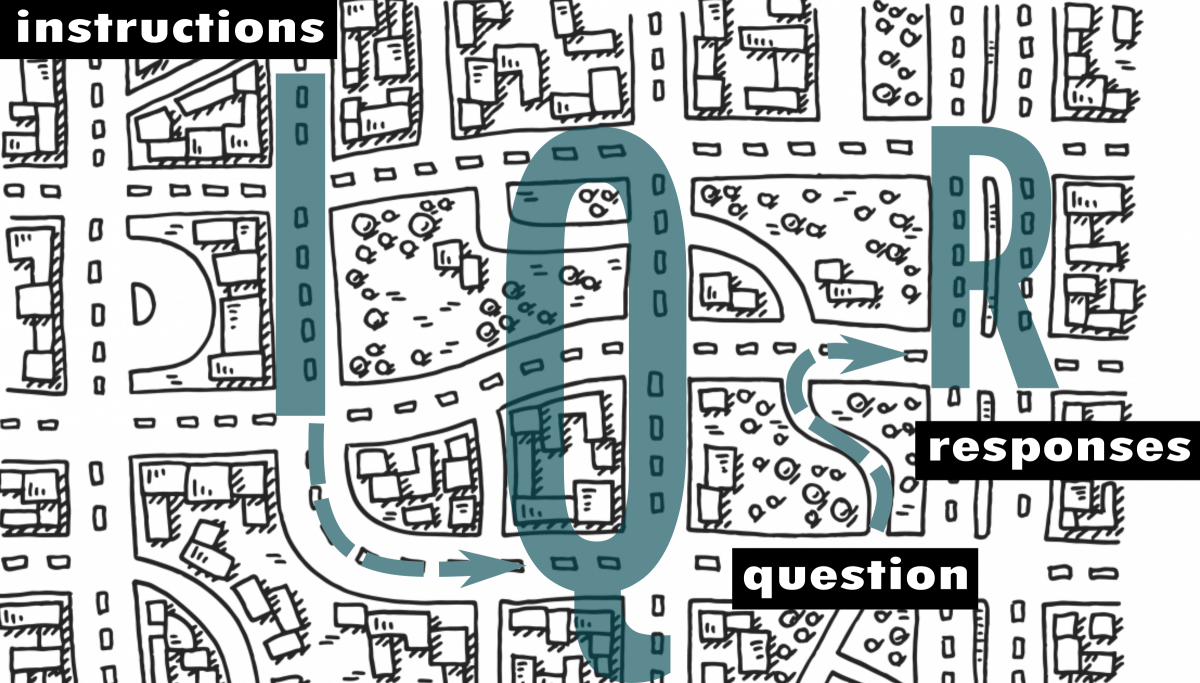
Multiple choice questions consist of three elements:
-
Instructions (check whether you will lose marks for incorrect guesses)
-
A question
-
A choice of responses
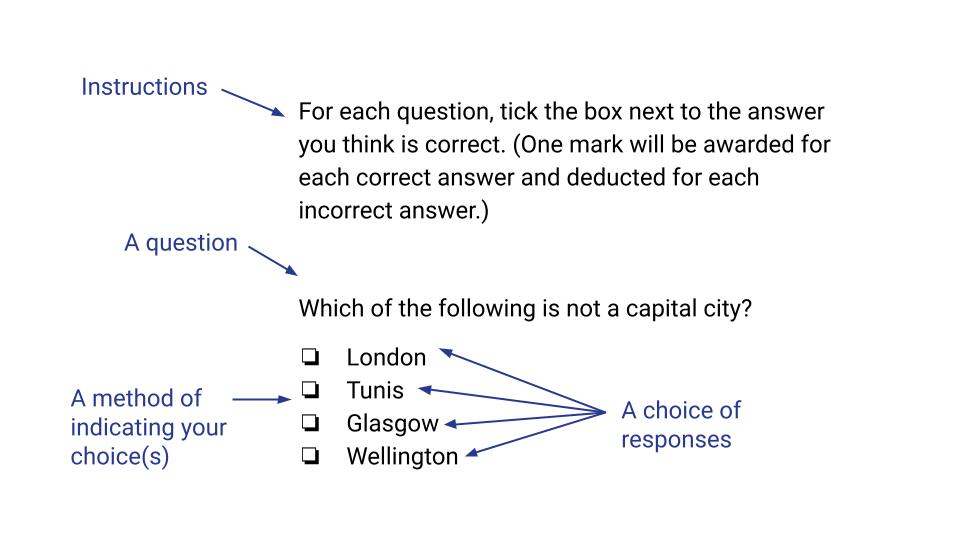
Multiple choice questions consist of four elements:
-
Instructions (check whether you will lose marks for incorrect guesses)
-
A question
-
A choice of responses
-
A method of indicating your choice(s)
Have a go at an MCQ
Select one answer.
Source: United Nations, Department of Economic and Social Affairs, Population Division (2019) World Population Prospects 2019: Highlights. Available at: https://population.un.org/wpp/Publications/Files/WPP2019_Highlights.pdf (Accessed: 16 April 2021).
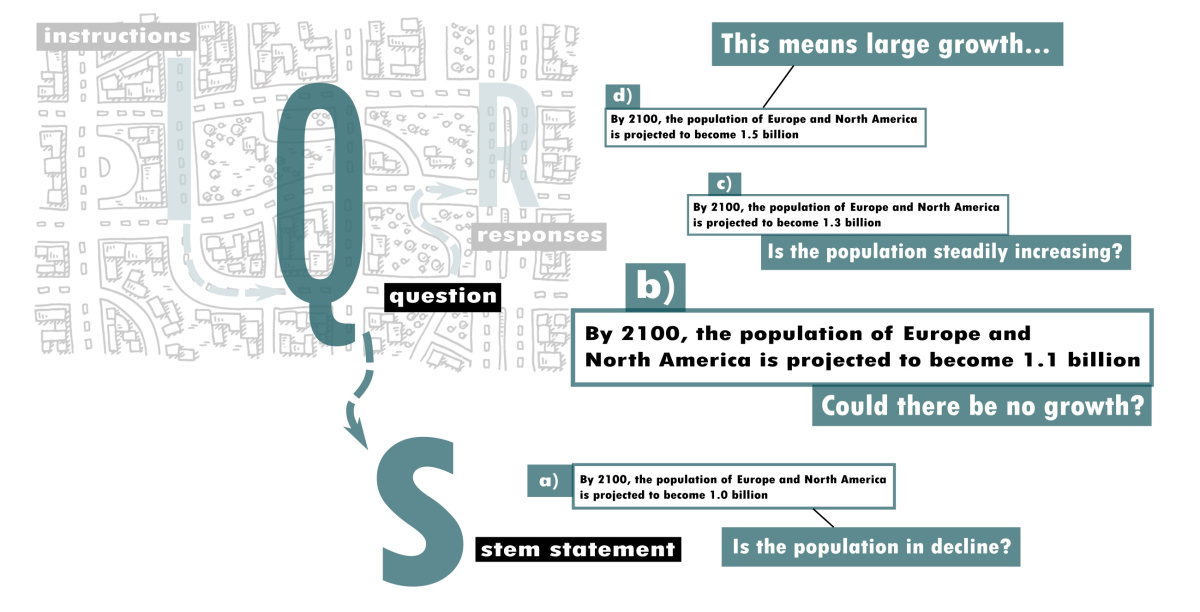
Unpicking the example
For the question:
“According to the UN Department of Economic and Social Affairs, the population of Europe and North America was 1.1 billion in 2019. By 2100, this is projected to become...”
a stem statement would be:
By 2100, the population of Europe and North America is projected to become 1.0 billion
Step 1: Find the ‘stem’
Each question generally contains words that can be used to make an affirmative statement (or ‘stem statement’), to which you can add each of the possible answers.
If you can isolate the stem, this will make it easier to identify what you are being asked.
Step 2: Apply the ‘stem’
Apply the stem to each of the choices, so you can test out which sounds correct. This can help you to recognise correct and incorrect answers. If you are still not certain of the answer, you may at least be able to eliminate some incorrect answers, thereby reducing the options.
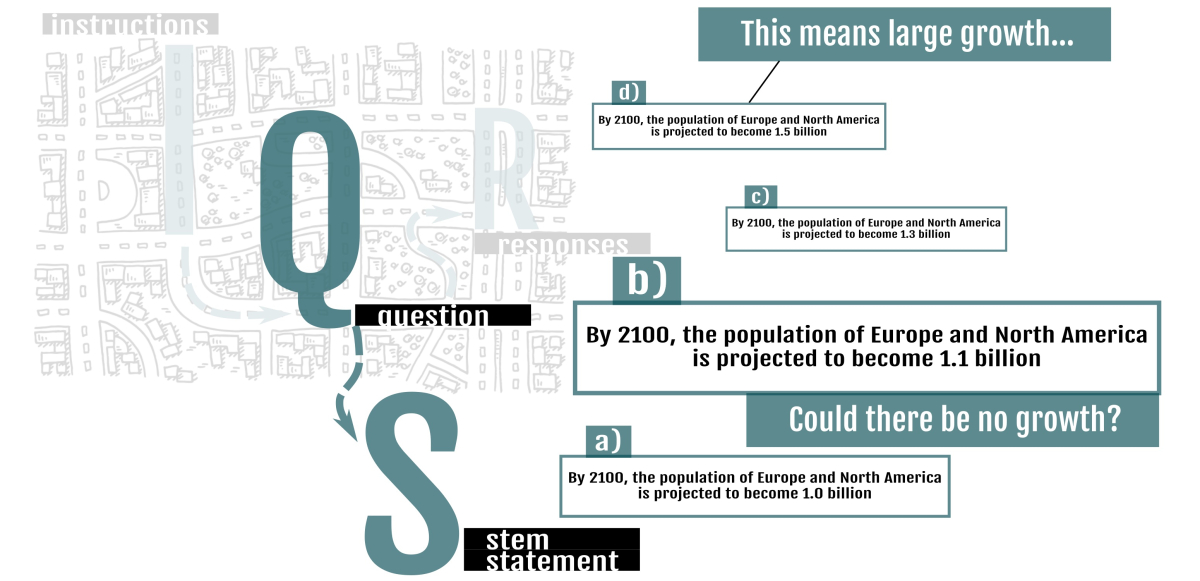
Example
For the question:
"According to the UN Department of Economic and Social Affairs, the population of Europe and North America was 1.1 billion in 2019. By 2100, this is projected to become:"
a ‘stem statement’ would be:
By 2100, the population of Europe and North America is projected to become 1.0 billion
Step 1: Find the ‘stem’
Each question generally contains words that can be used to make an affirmative statement (or ‘stem statement’), to which you can add each of the possible answers.
If you can isolate the stem, this will make it easier to identify what you are being asked.
Step 2: Apply the ‘stem’
Apply the stem to each of the choices, so you can test out which sounds correct. This can help you to recognise correct and incorrect answers. If you are still not certain of the answer, you may at least be able to eliminate some incorrect answers, thereby reducing the options.
Be strategic
Consider each of the strategies below. If you would like to apply one of these strategies to future MCQ exams, check the box to add it to a list of favourites which you can save to your journal.
Read each question carefully and identify the ‘stem’. Apply the ‘stem’ to each of the choices, to double-check your answer and to see whether any other choices could also apply.
If you don’t know the answer, using the ‘stem’ may help you spot the right choice.
Negative words such as no, not, never, none, neither this nor that, etc. make questions more complicated.
Rephrase the 'stem' so that it reads as a positive. For example:
Which of the following is not a capital city?
(a) London (b) Tunis (c) Glasgow (d) Wellington
Rephrase as a positive question:
Which of the following are capital cities? (London, Tunis and Wellington.)
Then ask yourself: which one(s) remain? (Glasgow.)
Before looking at the choices, see if you know the answer. Then check whether that is provided as a choice.
Qualifiers are words that narrow or define your choices, such as all, always, the most, sometimes, when ..., if ..., whenever ..., both this and that, etc. An answer that appears correct at first may cease to do so once you check the qualifiers.
Make sure that the qualifier is included in your stem, and apply this to each choice. This may eliminate some choices.
Rephrasing the ‘stem’ and each answer as true/false statements can help you spot correct answers or eliminate incorrect ones. For example:
In the Prisoner's Dilemma, which of the following is the most likely outcome?
- A cooperates, B cooperates
- A cooperates, B defects
- A defects, B cooperates
- A defects, B defects
Remember:
- If part of a potential answer is ‘false’, the whole statement must be false – even if some aspects are true
- If part of an answer is ‘true’, that doesn’t necessarily apply to the rest of the statement. Continue to check each part of the statement in case any element is false
Answer: 4.
Source: Grieco, J., Ikenberry, G.J. and Mastanduno, M. (2018) Chapter 6: War and its causes. Available at: https://www.macmillanihe.com/resources/CW%20resources%20(by%20Author)/G… (Accessed: 16 April 2021).
If you can’t spot the correct answer, use your subject knowledge and logical reasoning to reduce your number of choices. Work out which of the remaining choices is the most likely.
If there is no penalty for a guess, then guess rather than leaving blank.
If there is a penalty for an incorrect answer, weigh up the probability of whether your guess is right or wrong.
Take a look at some examples
Below is a selection of MCQs from different subject areas. Browse these to get a feel for how MCQs can be worded and what they are testing.
Multiple choice questions consist of three elements:
-
Instructions (check whether you will lose marks for incorrect guesses)
-
A question
-
A choice of responses
Have a go at an MCQ
Select one answer.
According to the UN Department of Economic and Social Affairs, the population of Europe and North America was 1.1 billion in 2019. By 2100, this is projected to become:
- 1.0 billion
- 1.1 billion
- 1.3 billion
- 1.5 billion
Source: United Nations, Department of Economic and Social Affairs, Population Division (2019) World Population Prospects 2019: Highlights. Available at: https://population.un.org/wpp/Publications/Files/WPP2019_Highlights.pdf (Accessed: 16 April 2021).
Correct answer: 1.3 billion
Unpicking the example
Each question generally contains words that can be used to make an affirmative statement (or ‘stem statement’), to which you can add each of the possible answers.
For the question:
“According to the UN Department of Economic and Social Affairs, the population of Europe and North America was 1.1 billion in 2019. By 2100, this is projected to become...”
a ‘stem statement’ would be:
“By 2100, the population of Europe and North America is projected to become 1.0 billion”
Step 1: Find the ‘stem’
Each question generally contains words that can be used to make an affirmative statement (or ‘stem statement’), to which you can add each of the possible answers. If you can isolate the stem, this will make it easier to identify what you are being asked.
Step 2: Apply the ‘stem’
Apply the stem to each of the choices, so you can test out which sounds correct. This can help you to recognise correct and incorrect answers. If you are still not certain of the answer, you may at least be able to eliminate some incorrect answers, thereby reducing the options.
Be strategic
Consider each of the strategies below. Make a note of those that you would like to use in future MCQ exams.
Use the ‘stem’. Read each question carefully and identify the ‘stem’. Apply the stem to each of the choices, to double-check your answer and to see whether any other choices could also apply. If you don’t know the answer, using the stem may help you spot the right choice.
Rephrase a negative stem as a positive. Negative words such as no, not, never, none, neither this nor that, etc. make questions more complicated. Rephrase the stem so that it reads as a positive. For example: Which of the following is not a capital city? (a) London (b) Tunis (c) Glasgow (d) Wellington. Rephrase as positive statement(s): Which of the following are capital cities? (London, Tunis and Wellington.) Which one(s) then remain? (Glasgow.)
Provide your own answer. Before looking at the choices, see if you know the answer. Then check whether that is provided as a choice.
Check for qualifiers. Qualifiers are words that narrow or define your choices, such as all, always, the most, sometimes, when ..., if ..., whenever ..., both this and that, etc. An answer that appears correct at first may cease to do so once you check the qualifiers. Make sure that the qualifier is included in your stem, and apply this to each choice. This may eliminate some choices.
Rephrase as true/false. Rephrasing the ‘stem’ and each answer as true/false statements can help you spot correct answers or eliminate incorrect ones.
In the Prisoner's Dilemma, which of the following is the most likely outcome?
- A cooperates, B cooperates
- A cooperates, B defects
- A defects, B cooperates
- A defects, B defects
Remember: if part of a potential answer is 'false', the whole statement must be false – even if some aspects are true. If part of an answer is 'true', that doesn't necessarily apply to the rest of the statement. Continue to check each part of the statement in case any element is false.
Answer: 4.
Source: Grieco, J., Ikenberry, G.J. and Mastanduno, M. (2018) Chapter 6: War and its causes. Available at: https://www.macmillanihe.com/resources/CW%20resources%20(by%20Author)/G… (Accessed: 16 April 2021).
Eliminate unlikely answers. If you can’t spot the correct answer, use your subject knowledge and logical reasoning to reduce your number of choices. Work out which of the remaining choices is the most likely.
Best guess? If there is no penalty for a guess, then guess rather than leaving blank. If there is a penalty for an incorrect answer, weigh up the probability of whether your guess is right or wrong.
Take a look at some examples
Below is a selection of MCQs from different subject areas. Browse these to get a feel for how MCQs can be worded and what they are testing.
Business
What is EBIT? (Select all that apply.)
- The net income that is earned from all ongoing business activities without taking the cost of capital and taxes into account
- Total revenue minus cost of goods sold
- Another term for net profit
- Another term for operating profit
Answer: 1 and 4.
Source: Sternad, D. (2019) Chapter 9: Achieving results. Available at: https://www.macmillanihe.com/resources/CW%20resources%20(by%20Author)/S… (Accessed: 16 April 2021).
Chemistry
Measurements which are precise will always have a:
- Large systematic error
- Small systematic error
- Large random error
- Small random error
Answer: 4. Information about precision does not allow us to make any comment on the presence or absence of systematic errors.
Source: Lewis, R. & Evans, W. (2018) Chemistry (5th edn). London: Red Globe Press.
Geography
Which of the following is the longest river in Africa?
- Amazon
- Nile
- Zambezi
- Limpopo
Answer: 2.
Source: Cottrell, S. (2012) The Exam Skills Handbook (2nd edn). London: Red Globe Press.
Law
Which area of law will be appropriate for the use of cohabitants in disagreement over distribution of real property?
- The law of tort
- The law of trusts
- Family law
- Constitutional law
Answer: 2. Married couples are protected by the principles of family law whereas unmarried couples may need to apply the law of trusts.
Source: Davey, S. (2020) Chapter 3: Cohabitation. Available at: https://www.macmillanihe.com/resources/CW%20resources%20(by%20Author)/D… (Accessed: 16 April 2021).
Maths
A publisher’s printer produces 3500 sheets of paper per hour. If the speed of printing is decreased in the ratio 7:4 how many sheets will be printed in 12 hours?
- 24,000
- 24,500
- 25,000
- 25,500
Answer: 1.
Source: Stroud, K.A. and Booth, D.J. (2020) ‘Additional Questions Part 1: Arithmetic’. Available at: https://www.macmillanihe.com/companion/Stroud-Engineering-Mathematics/E… (Accessed: 16 April 2021).
Nursing and Medicine
Which of the following is not a type of blood vessel?
- Artery
- Vein
- Vesicle
- Capillary
Answer: 3.
Source: Cottrell, S. (2012) The Exam Skills Handbook (2nd edn). London: Red Globe Press.
Politics
The area that extends 12 nautical miles from a state's shoreline is its __________.
- Territorial Sea
- Exclusive Economic Zone (EEZ)
- High Seas Exclusion Area (HSEA)
- Sovereign Waterway (SW)
Answer: 1.
Source: Grieco, J., Ikenberry, G.J. and Mastanduno, M.. (2018) Chapter 5: Framing international relations: The role of laws and organizations. Available at: https://www.macmillanihe.com/resources/CW%20resources%20(by%20Author)/G… (Accessed: 16 April 2021).
Psychology
Karen studies the details of how and why infants bond to their primary caregivers – and the consequences of this bonding process for later development. Karen is most likely:
- A socioemotional theorist
- An attachment theorist
- A family trait theorist
Answer: 2.
Source: Pelham, B. (2018) Chapter 6: Six children and a pickle barrel: parenting, step-parenting and grandparenting. Available at: https://www.macmillanihe.com/resources/CW%20resources%20(by%20Author)/P… (Accessed: 16 April 2021).
Sociology
For sociologists, individual achievement is typically:
- Down to the individual
- A collective accomplishment
- Explained by reference to the person's parents
- Unaffected by social structures
Answer: 2.
Source: Matthewman, S., Curtis, B. and Mayeda, D. (2021) ‘MCQ Testbank’. Available at: https://www.macmillanihe.com/companion/Matthewman-Being-Sociological-3e… (Accessed: 16 April 2021). Editor’s note: This MCQ testbank is only available to lecturers.