
Take on new writing challenges

Challenging yourself with more complex and varied writing exercises can help you become a better writer, both in terms of how you manage the writing process and the quality of your output.

Consider this:
Many people learn how to bake a simple sponge cake as a child, as it’s a straightforward recipe. Sponge cakes are tasty, but if you wanted to become a better baker you’d probably want to experiment with other recipes. You’d challenge yourself to create more complex desserts: fruit tarts, cinnamon buns, macarons, and so on.
In so doing, you’d build your stamina (as these recipes will involve new and more difficult processes, and will take longer to complete) and capacity to overcome challenges (as the more complex the recipe, the more potential there is that something can go pear-shaped).

Writing is no different. Experimenting with different approaches to writing and writing tasks will increase your stamina – that is, your ability to sustain mental effort and ‘stick with’ tasks over a long period of time.
Become more flexible with:
- How long you write for
- What you write
- Who you write for
- How you tackle writing problems
Add more stretch. Do so at your own pace, so you can handle the challenge without undue stress.
There are many ways in which you can develop your writing stamina. Here are a few to get you started:
Build the time incrementally – a few minutes at a time, until you find your optimum time – so that you are able to spend longer chunks of time focused on writing.
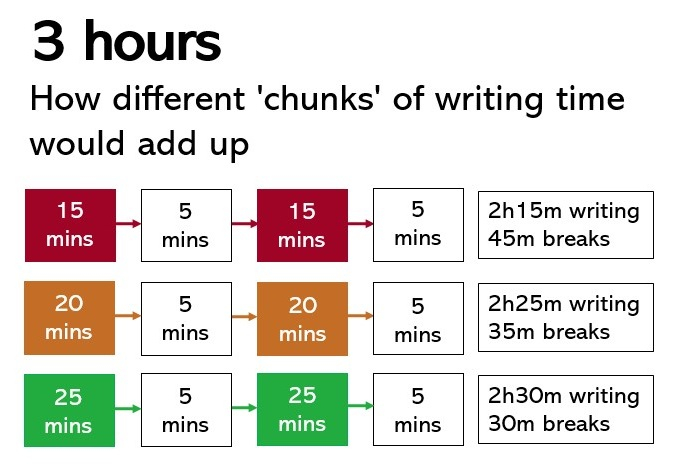
You might find it helpful to visualise these chunks. In the graphic below, you can see:
- What each pattern of writing time and breaks equates to over three hours of study
- How much extra writing time you could have, just by increasing your study slots by a few minutes
If you don’t have a clear sense of what you want to achieve in the block of time you have set aside for writing, or find it hard to stick with it, take a look at the article Make each study session count.
Stick with difficulties for longer
Writing doesn’t always come easily. If you find you give up quickly when the going gets tough, it is worth building your capacity to grapple with the difficulties you encounter when writing.
What challenges do you face when writing? How might you overcome them? Note any thoughts and ideas in the box, then save them to your journal.
Stuck for ideas? Click 'Show examples' to see some common difficulties and suggestions for how you might overcome them.
- Don’t know where to start? Experiment with free-association. Grab a sheet of paper, and jot down anything that springs to mind on the topic: keywords; relevant schools of thought; current debates; case studies and/or examples; etc. You can refine these rough notes later if needed
- One paragraph, many ideas? Some students find that including headings in their drafts helps them avoid rambling and stay ‘on topic’ in each paragraph. You can delete the headings from your final draft before you submit your assignment
- Getting bogged down in checking spelling and grammar and losing momentum? Factor in a few days before your assignment is due for editing and proofreading. While drafting your assignment, ignore mistakes. Focus instead on getting your ideas down and constructing an argument
- Over the word count and struggling to trim your assignment down? Re-read your assignment line by line. Be critical: have you used two words where one would do? Is there a quote that isn’t supporting your argument that could be cut? Are there any long-winded sentences that could be made more concise?
You’ll find more ideas for getting started with assignments and overcoming writer’s block in the Writing skills module.
Write for longer
Build the time incrementally – a few minutes at a time, until you find your optimum time – so that you are able to spend longer chunks of time focused on writing.
If you don’t have a clear sense of what you want to achieve in the block of time you have set aside for writing, or find it hard to ‘stick with it’, take a look at the article Make each study session count.
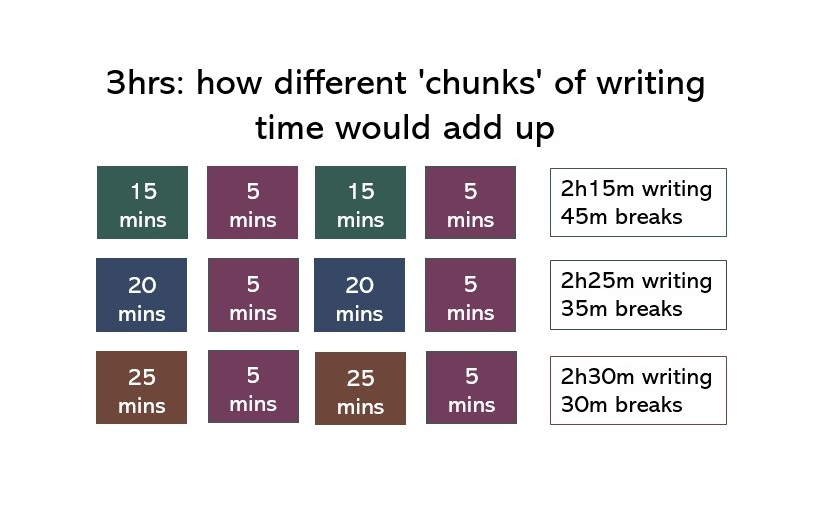
You might find it helpful to visualise these chunks. In the graphic, you can see:
- What each pattern of writing time and breaks equates to over three hours of study
- How much extra writing time you could have, just by increasing your study slots by a few minutes
Write for longer
Build the time incrementally – a few minutes at a time, until you find your optimum time – so that you are able to spend longer chunks of time focused on writing.
If you don’t have a clear sense of what you want to achieve in the block of time you have set aside for writing, or find it hard to ‘stick with it’, you might find it helpful to read the article Make each study session count.
Take on more varied tasks
Stretch your intellect and hone your writing skills by taking on tasks that will offer you new challenges and enable you to develop your ability to put difficult concepts into writing. For example, you could:
- Write an article for a student magazine, zine or newspaper
- Compile guidance for new students
- Contribute to a shared wiki
- Produce a piece of creative writing, such as a poem, short story or play
More from Bloomsbury
Feeling inspired? Enhance your approach to writing with 50 Ways to Excel at Writing, by Stella Cottrell.