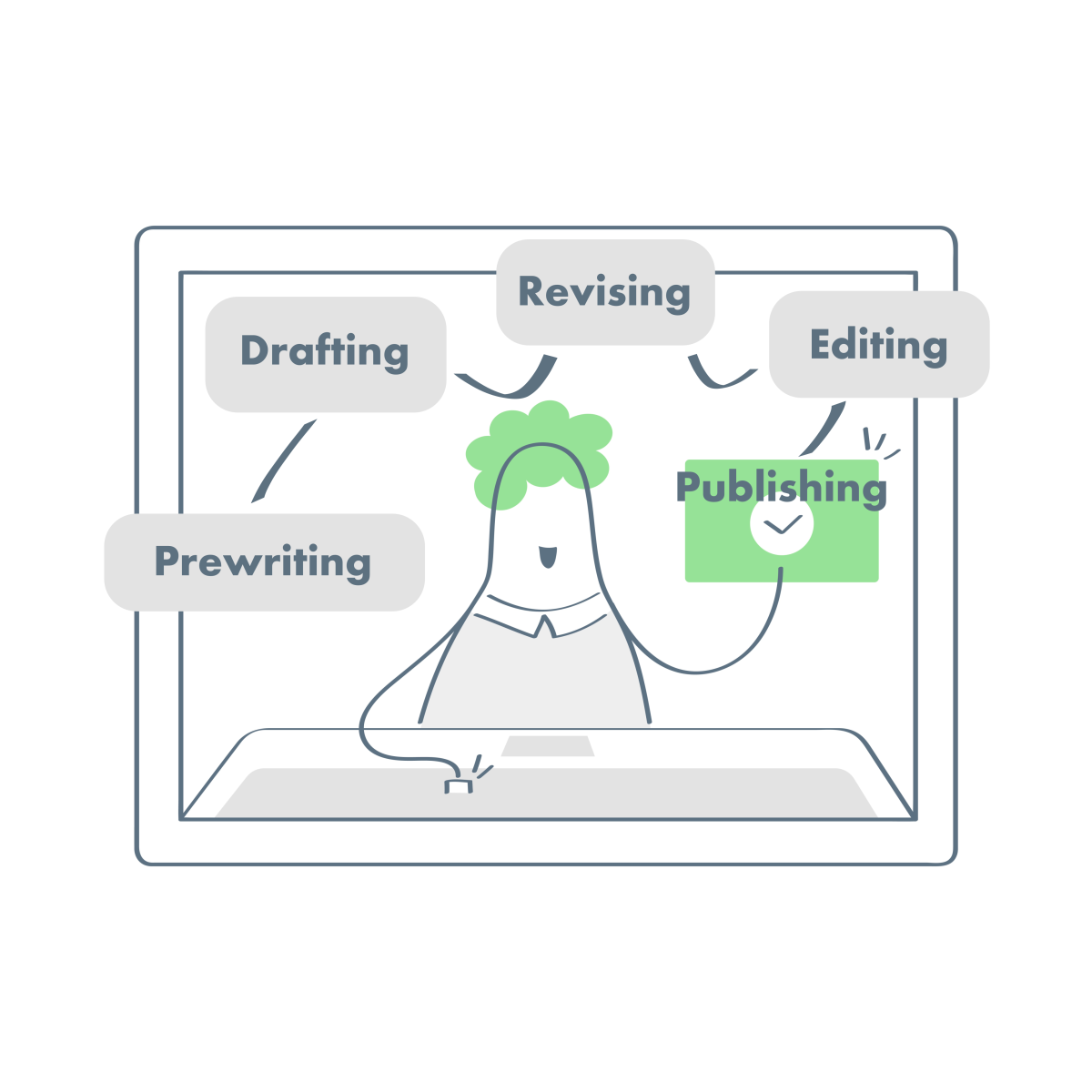
Make the writing process work for you

  • Experiment with different ways of approaching writing
  • Establish a writing process that works for you

Person looking at a sign with two arrows: right way and wrong way

There isn’t just one mysterious or magical way of writing successfully: it is a case of finding a process that works for you.

You might write better if you create a detailed plan – or you might prefer to jot ideas down on paper first, see what emerges and use that to help you plan out your piece.

Being aware of, and developing, that process is itself worthy of your attention.

Small character with signposts

Original

There isn’t just one mysterious, magical way of going about writing successfully: it is a case of finding a process for writing, and for developing your writing, that works for you.

You might write better if you create a detailed plan – or you might prefer to jot ideas down on paper first, see what emerges and use that to help you plan out your piece.

Select the arrow below to view three approaches to writing.

Small character choosing a stage in the writing process

In focussing on the end product, it is easy to overlook the writer (you), your writing process and your relationship with the process of writing.

If you find it hard to get going when you need to write, struggle to stick with it or don’t enjoy it, then it is worth considering how you approach writing as a task.

Spotlight on a man

Stephen King

Six pages a day

Sea stacks along the coast

Ernest Hemingway

Write every morning

Caged birds

Maya Angelou

Write 7am to 2pm

HIDDEN A selection of habits from successful writers:

Caged birds

Writing from 7am to 2pm

Maya Angelou

Two bridges running parallel into the distant

Take brief breaks

Khaled Hosseini

Sea stacks along the coast

Every morning

Ernest Hemingway

Spotlight on a man

Six pages a day

Stephen King

Winding road

Drink half a pot of coffee

Gillian Flynn

Block of flats

Edit as I go along

Zadie Smith

Habits of some writers
Bird cage

Writing from 7am to 2pm

Maya Angelou

Sea stacks along the coast

Every morning

Ernest Hemingway

Kite in the sky

Take brief breaks

Khaled Hosseini

Block of flats

Edit as I go along

Zadie Smith

Spotlight on a man

Six pages a day

Stephen King

Notes in a diary

Drink half a pot of coffee

Gillian Flynn

Identify the best writing process for you

Consider these potential variations in the writing process. Which of them might help with some, or all, of your writing process?

Focus

Do you...

  • Find it easiest to write first thing in the morning, or later in the day? Experiment with writing at different times of day to identify when you’re most productive
  • Complete a rough draft before reviewing your work, or review your writing after each section? If you find it difficult to review your work objectively, try putting your work to one side for a day and coming back to it with fresh eyes
  • Write in the same place, or vary where you write? If you’re finding it hard to focus on the task at hand, experiment with writing in different places
  • Prefer writing at a clear desk, or in a cluttered space?
Focus

Do you...

  • Work best in short spells, or find it better to block out longer periods of time for study? Experiment with shorter stretches if you find yourself losing focus or getting distracted 
  • Take a ten-minute break every hour, or only break when you’ve completed a task? If you find your breaks are interrupting the flow of a task or becoming longer than the study sessions themselves, try varying when you take breaks
Focus

Do you…

  • Prefer generating ideas on a tablet, or mapping them out on paper? If you struggle to get started when faced with a blank screen or sheet of paper, you might find it helpful to keep an ideas book so you can note down ideas as and when they occur to you
  • Write with nibbles to hand, or reward yourself with a treat at the end of your study session?
  • Write by yourself, or with others? You might like to try setting up a writing buddy group if you need an extra incentive to make headway with your writing – but take care to avoid accidental plagiarism by keeping any assignment drafts to yourself
  • Use support from your university or college? Don’t be afraid to reach out to your tutors or study skills advisors for help if you need it: they want you to succeed
Focus

Do you…

  • Dive straight into the task, or map out your ideas before writing? Jumping straight into the task is a risky strategy. Make sure you clarify the task and understand what's expected of you before you begin 
  • Stick to your plan, or flex plans a lot? A good plan can save you time, but try not to be too rigid in your approach: as your understanding of a topic develops, so too will your ideas. Be prepared to rework your plan if needed
  • Plan broad word allocations, or let it flow? If you often need to cut down your assignment to meet the word limit, you might find it helpful to review this guidance on structuring assignments
Focus

Do you…

  • Aim to enjoy the task? There is enjoyment to be found in learning anything, if you are open to it. If you’re feeling at all negative about your studies, have a go at creating a 'joy list' to revive your enthusiasm
  • Feel calm and collected when you sit down to study?
  • Approach the task mindfully? If you’re unsure how to apply mindfulness to study, start by having a go at a two-minute meditation before you settle down to work
  • Feel excited or curious about your study task?
  • Persevere when faced with challenges? If you hit a roadblock with your assignment, take time to step back and reflect on what you’ve achieved so far, and what help you need to move forward
Other things that help me write...

Jot down anything else that you feel helps, or could help, your writing process in the box below.

Changing your writing process, and your relationship to that process, could make the task easier and more fun. If you have a great writing process already, experiment to see if it could be even better.

More from Bloomsbury

Feeling inspired to pick up a pen or put fingers to keyboard? Great! If writer's block strikes again, take a look at 50 Ways to Excel at Writing by Stella Cottrell for more tips to get you back in the (writing) groove.


Focus
  • Write every day
  • Write most days
  • Write first thing in the morning
  • Write through the night
  • Write at a clear desk
  • Write in a cluttered space
  • Review your writing after each section
  • Review your writing at set times
  • Complete a rough draft before reviewing your writing
  • Write in the same place
  • Vary where you write
Focus
  • Write in short spells
  • Write in long blocks
  • Write in varying time blocks
  • Take breaks when you feel like it
  • Break when you complete a task
  • Break at set times
  • Vary how you take breaks
Focus
  • Generate ideas on a tablet or electronic device
  • Map ideas out on paper
  • Keep an ideas book
  • Write with nibbles to hand
  • Have writing buddies
  • Use support from your university or college
Focus
  • Let it flow
  • Just dive in
  • Map out your ideas before writing
  • Develop ideas through writing
  • Work up ideas in your head
  • Flex plans a lot
  • Stick to a formula
  • Plan broad word allocations
  • Stick to your plan
  • Plan backwards from deadlines
Focus
  • Aim to enjoy it
  • Be mindful
  • Be calm
  • Be excited
  • Be curious
  • Persevere
Related tags: