
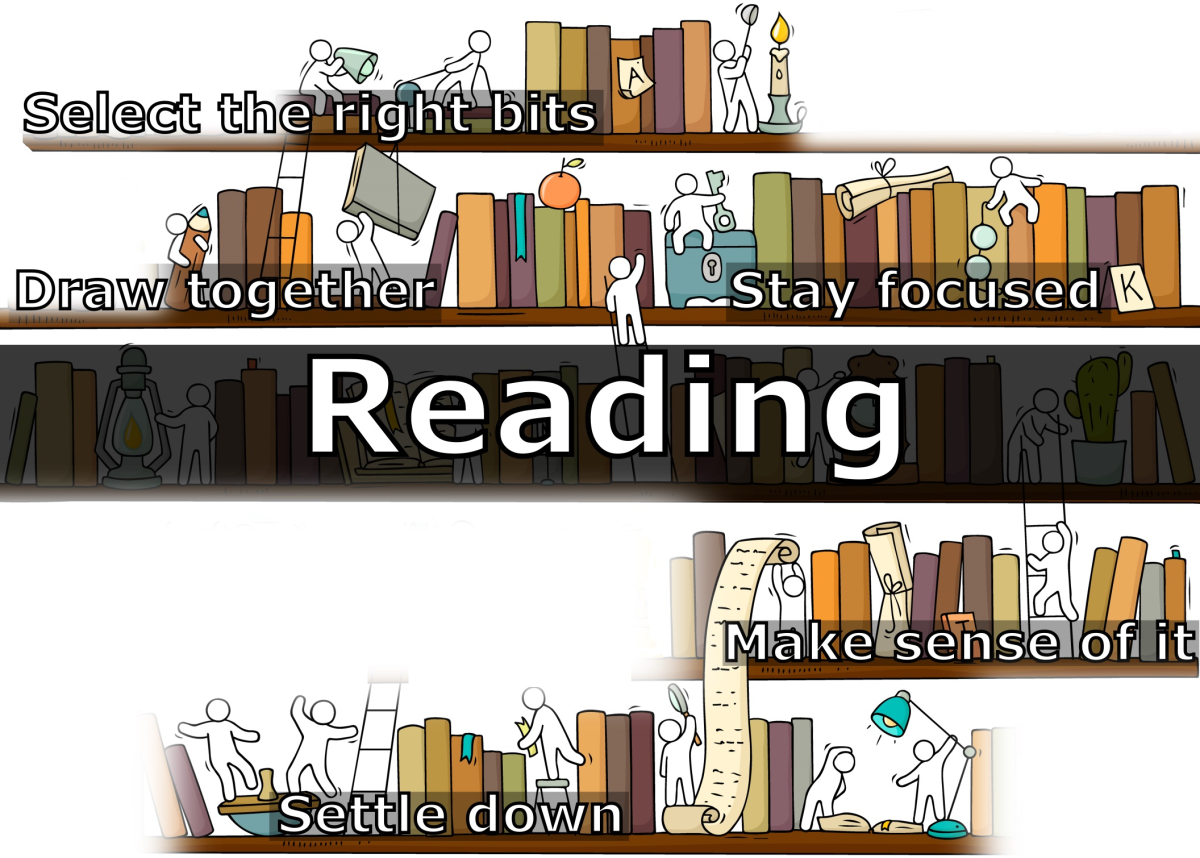
To get more out of your reading session, it's worth asking yourself how you deal with the following aspects:
- Selecting the most relevant passages
- Settling down to reading
- Making sense of the material
- Staying focused and getting through the text
- Drawing on sources appropriately in your assignments: synthesis of information
Each component poses its own challenges.
Being present
– more mindful –
in your reading can make you aware of your readiness to take on information.

You’re probably so good at reading that you can do it ‘on autopilot’ alongside other tasks such as listening to music, eating, walking, and maybe even taking notes.
You can combine the technical act of reading with comprehending the meaning of what you read and critiquing it.
The downside of this is that you can drift off into thoughts, or even into focusing on a second task, without realising.
You’re probably so good at reading that you can do it ‘on autopilot’ alongside other tasks such as listening to music, eating, walking, and maybe even taking notes.
You can combine the technical act of reading with comprehending the meaning of what you read and critiquing it.
The downside of this is that you can drift off into thoughts, or even into focusing on a second task, without realising.
Why this matters
This can be especially frustrating for students as reading constitutes such a large part of study and available time. If your attention keeps drifting, this can have several unwanted consequences. Here are just a few:
It may not be obvious to you that you have missed essential information needed in order to understand and apply the material.
It’s likely that you’ll need to re-read passages or even pages.

You lose precious time as a result – time that could have been spent on other things such as catching up with friends or family, snoozing, exercising or unwinding with hobbies.
You waste time available for other aspects of study or that assignment.

It can feel boring repeating tasks, thereby increasing the potential for impatience to finish and superficial reading.

‘Mindless reading’ – or reading ‘on autopilot’
If you’ve ever read paragraphs, or even several pages, without taking in a word of what you have read, you’re not alone.
You’re probably so good at reading that you can do it ‘on autopilot’ alongside other tasks such as listening to music, eating, walking, and maybe even taking notes. You can combine the technical act of reading with comprehending the meaning of what you read and critiquing it.
The downside of this is that you can drift off into thoughts, or even into focusing on a second task, without realising.
Why this matters
This can be especially frustrating for students as reading constitutes such a large part of study and available time.
If your attention keeps drifting, this can have several unwanted consequences:
- It may not be obvious to you that you have missed out essential information needed in order to understand and apply the material
- It’s likely that you’ll need to re-read passages or even pages
- You lose precious time as a result – time that could have been spent on other things such as catching up with friends or family, snoozing, exercising or unwinding with hobbies
- You waste time available for other aspects of study or that assignment
- It can feel boring repeating tasks, thereby increasing the potential for impatience to finish and superficial reading rather than being fully focused and interested
Reading more mindfully
Reading is a task that calls on cognitive skills, such as concentration, information processing and recall, that research shows benefit from meditation. If you build your practice over several weeks and continue it across your course, you are likely to improve your:
- Reading persistence
- Understanding and recall of what you read
Select the tabs below to view five ways to sharpen your focus when reading.
More from Bloomsbury
Feeling inspired? Find more guidance on taking a mindful approach to study in Mindfulness for Students by Stella Cottrell.








Feedback